
Financial Novelty refers to the long-term planning and management of financial resources to support organizational objectives, maintain profitability, and maximize shareholder value. It encompasses decisions related to capital structure optimization, investment planning, cost management, revenue growth, and risk mitigation.
Many leaders believe they’ve adopted productive mindsets for growth and value creation, but their attitudes don’t always translate into the behaviors and actions necessary to achieve targeted growth objectives. Leading organizations translate growth intent into sustained performance by making clear bets, allocating resources deliberately, and staying committed through uncertainty.
Financial leadership today demands far more than managing budgets or ensuring compliance, it requires shaping strategy, driving technology adoption, and aligning financial decisions with long-term stakeholder value. The role of finance has evolved into a central force behind business transformation. This includes four concrete capabilities essential for financial leaders: reallocating capital in response to market shifts, leading digital initiatives, embedding ESG metrics, and influencing nonfinancial KPIs such as innovation return and customer lifetime value. Traditional leadership models that focus on variance analysis and quarterly reporting fail to equip CFOs for real-time, cross-functional leadership. CFOs who embrace data fluency, experimentation, and sustainability outperform peers in agility and resilience. It calls for executive development programs that incorporate training in digital tools, ESG analytics, and strategic scenario planning. These changes are critical not just to redefine finance functions, but to equip organizations for growth and stability in volatile, tech-driven markets.
The paradigm of financial leadership has evolved significantly from traditional roles centered on financial reporting, compliance, and cost control to encompass strategic decision-making, digital transformation, and value creation. In the modern business environment marked by volatility, uncertainty, complexity, and ambiguity (VUCA), financial leaders such as Chief Financial Officers (CFOs) are now expected to act as strategic enablers of organizational growth and innovation.
“Cultivating a growth mindset is the holy grail for every company”
Strategic Agility in Financial Decision-Making: Strategic agility is not solely a technical capability but also a leadership mindset that emphasizes flexibility, cross-functional collaboration, and risk tolerance.
Digital Transformation and Financial Leadership: Digital transformation is redefining not only how financial operations are conducted but also the very nature of financial leadership. Today’s financial leaders are expected to champion digital initiatives, from automating routine accounting tasks to deploying advanced analytics for predictive decision-making. This represents a reconceptualization of financial leadership as a digitally enabled, innovation-oriented discipline. Leaders who embrace digital transformation are better positioned to drive enterprise agility, reduce operational risk, and unlock new growth pathways. However, realizing this vision requires not only technological investment but also a rethinking of talent, governance, and performance metrics. Digital transformation further reshapes financial strategy execution. Financial analytics dashboards provide real-time monitoring of performance trends, enabling predictive modeling and early risk detection
Growth Orientation and Innovation Stewardship: Modern financial leadership is increasingly characterized by a forward-looking, growth-oriented mindset that extends beyond traditional financial stewardship. Financial leaders are now expected to not only safeguard capital but also deploy it strategically to foster innovation, support business scalability, and enable competitive differentiation. This transformation reflects a broader shift from cost containment to value creation, positioning CFOs as architects of sustainable growth.
Balance short-term results with long-term value creation: Too many growth strategies stall because leaders don’t treat them with the same rigor they apply to other long-term investments. Companies that do both—generate insight and take action—see rewards in terms of growth and outperformance. We need to be agents for growth from a human perspective, but we also need to help our clients create agents to drive growth more systematically, using MRP (Material Requirements Planning) and ERP (Enterprise Resource Planning) systems.
Scalable Infrastructure Development: Execution requires data and rigorous tracking, even when access is challenging. But I like to say that cost initiatives—which this certainly is not—are often run with very rigorous systems. There’s a commitment to the work and a commitment to the organization.
Financial Intelligence is a Leadership Skill: Financial intelligence means more than reading financial statements. It’s the ability to interpret financial data and use it to guide operational decisions across the organization. Leaders with strong financial awareness understand margins by product or service, unit economics, cost structures, cash flow timing, return on investment for key initiatives.
This level of insight allows executives to connect strategy with financial outcomes. Companies that operate this way treat finance as an operating system for decision-making, not just a reporting function. Organizations that recognize and leverage the strategic value of financial leadership position themselves for accelerated growth and long-term success in an increasingly competitive marketplace. From his experience as CFO for global firms across various industries, I can attest that this strategic approach to financial leadership consistently delivers superior results.
A portfolio approach to growth: We know that growth requires teamwork. At the heart of this success lies a growth mindset-the belief that abilities, intelligence, and success can be developed through effort, learning, and persistence. But a growth mindset isn’t just an individual trait; it’s a cultural advantage. Organizations that embed this philosophy into their workplace see greater innovation, higher employee engagement, and long-term business success. The challenge lies in Shifting from a fixed mindset culture—where failure is feared, and talent is seen as static—to one that encourages continuous development and learning.
Growth Starts at the Top: For a growth mindset culture to take root, it must start with leaders and managers. Employees look to leadership for signals on how to handle challenges, failures, and development. If leaders model resilience, curiosity, and a willingness to learn, their teams will follow. Cultivating a growth mindset isn’t a one-time initiative—it’s a long-term investment in your people and your business.
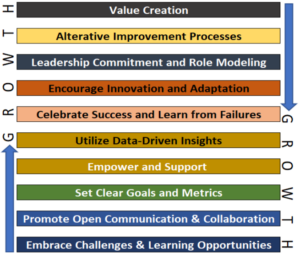
By embedding these principles into your organizational culture and practices, you can cultivate a sustainable growth mindset focused on continuous improvement. This mindset not only enhances operational efficiency and innovation but also fosters a resilient and adaptive organization prepared for future challenges and opportunities.